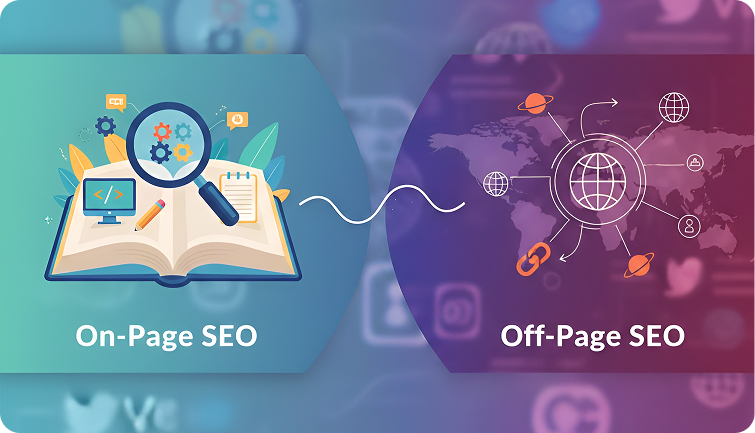
On-Page vs Off-Page SEO: What’s the Difference and Which Is Better for Your Business in Canada?

Many business websites in Canada have been online for years, still they do not appear where owners expect them in Google search. The site may look fine, pages are written, services are clear, but traffic stays low or comes without results. In most cases, this situation is linked with SEO work that is either incomplete or focused only on one side.

On-page SEO and Off-page SEO are usually discussed together, but they behave very differently. They also create confusion, especially for small and mid-size businesses that want clear answers. Some are told content is everything, others are told backlinks matter more. The reality is not so clean or fixed. This article explains how on-page and off-page SEO work, how they show results in real situations, and which one may matter more for businesses operating in Canada.


Not Sure Why Your SEO Isn’t Working?

Find out whether on-page or off-page SEO is holding your website back in Canada.

How does on-page SEO usually show problems first?

On-page SEO is noticed when something feels wrong inside the website. Pages may exist, but do not rank. Keywords are added, still Google does not respond. This happens often with service pages that are written once and never reviewed again. Most on-page issues are not dramatic. Headings may not clearly say what the page is about. Text may jump between ideas. Titles might look fine to humans, but search engines read them differently. These are common situations, especially on websites built quickly or updated many times by different people.

In Canada, on-page SEO is also affected by language habits. Spelling differences, local terms, and location references matter more than expected. A page written in general language may rank differently from one that quietly reflects how people search in a specific region. Technical parts also live inside on-page SEO. Page speed, mobile display, internal links, and URL structure all shape how search engines read the site.  

How does Off-page SEO grow more slowly and feel less clear?

Off-page SEO feels distant for many site owners. It happens outside the website and is not fully controlled. Mentions happen without notice. Reviews come slowly. This makes off-page SEO feel unpredictable. Backlinks are the most discussed part, but off-page SEO is not only about links. It includes how often a business name is mentioned, where it is listed, and how trusted those sources are. For Canadian businesses, local directories, industry websites, and regional media often carry more weight than random global links.

Off-page SEO does not show quick movement. A link added today may not change rankings for months. Several mentions may be needed before any effect appears. This slow pace can make businesses think it is not working, even when it is building value quietly. Search engines use off-page signals to judge trust. When many similar businesses exist, these external signals help decide which ones deserve higher visibility. That is why off-page SEO becomes more important in crowded markets like major Canadian cities.

On-Page SEO vs. Off-Page SEO

Aspect On-Page SEO Off-Page SEO
Area Inside the website itself, on pages that visitors and search engines see Outside the website, on other platforms, websites, and online spaces
Level of control Mostly controlled by the site owner or editor, changes can be made directly Limited control, depends on other websites, users, and external responses
Efforts Writing and adjusting page text, headings, titles, links, and layout Gaining mentions, links, reviews, and references from external sources
Visible results Changes may show impact in a shorter time, sometimes within weeks Results usually appear slowly and may take months to reflect
Common issues Pages exist but do not rank, unclear topics, weak internal structure Site looks good, but lacks trust, authority, or external recognition
Role in search rankings Helps search engines understand what the page is about Helps search engines decide how trustworthy the site appears
Impact on local Canadian search Strongly affected by location wording and regional language Influenced by local listings, Canadian directories, and regional mentions
Long-term behavior Needs regular updates as the content and structure age Builds gradually and often stays stable once established

Not Sure Where to Focus Your SEO Efforts?

We analyze what your site needs right now — clarity, trust, or both.

Which SEO type is better?

The question of which SEO type is better sounds simple, but it rarely has a single answer. On-page SEO builds clarity. Off-page SEO builds trust. One without the other creates an imbalance. A site with strong backlinks but weak pages may attract attention but fail to hold rankings. A site with good content but no external support may stay invisible. Search engines seem to look for consistency rather than extremes.

New websites often benefit more from on-page work first. It helps search engines understand what the site is about. Older websites that stopped growing often need off-page signals to move again. The better choice depends on what is missing, not on preference.

Where do both SEO types overlap in ranking?

On-page and off-page SEO are not fully separate. Good content naturally invites links. Clear structure helps external value flow across the site. Weak internal linking can reduce the benefit of strong backlinks. Search engines read patterns, not tasks. A site that looks strong inside but invisible outside raises questions. A site known everywhere but unclear internally does the same. This overlap explains why focusing only on one side gives unstable results. Balance creates steadiness.

How do businesses usually decide where to focus?

Most businesses do not need complex audits to decide. Pages that rank but do not convert often point to on-page issues. Pages that never rank at all may lack off-page support. Looking at competitors often reveals the gap. Some have similar content but more mentions. Others have a cleaner structure. These differences explain rankings more clearly than technical theories. Search engine optimization decisions work best when based on observation, not formulas.

Conclusion

On-page SEO shapes how a website speaks. Off-page SEO shows how others respond to that voice. For Canadian businesses, both matter, but at different times and in different ways. Rather than choosing one side, effective SEO usually shifts focus over time. First clarity, then trust, then refinement again. Search engines seem to reward this steady alignment. SEO is not about choosing a winner. It is about keeping the system balanced enough for search engines to feel confident showing the site to real people.

Ready for SEO That Actually Moves Rankings?

Mindcob helps Canadian businesses balance on-page clarity and off-page trust.

Frequently Asked Questions

Is on-page SEO enough for a small business in Canada?

In many smaller cities or low-competition areas, on-page SEO may be enough to bring visibility. Clear pages, correct location signals, and simple structure often help a site appear in local searches. Still, once competitors improve their own sites, off-page signals may start to matter more than expected.

Backlinks are a large part of off-page SEO, but they are not the whole picture. Mentions, business listings, reviews, and references from trusted sources also play a role. Search engines look at the wider presence of a business, not only how many links point to it.

How long does off-page SEO usually take to show results?

Off-page SEO moves slowly in most cases. Changes may not appear for several months, especially in competitive industries. This delay does not mean nothing is happening, but it often tests patience and expectations.

Can on-page SEO hurt rankings if done wrong?

Yes, it can. Overuse of keywords, unclear headings, or messy internal links may confuse search engines. Pages may rank lower even when content exists. On-page work needs balance, not force.

Should on-page and off-page SEO be done at the same time?

They can be, but timing matters. Many businesses start with on-page SEO to fix clarity issues, then move toward off-page efforts. Doing both without understanding what the site actually needs may end in a low ranking.