

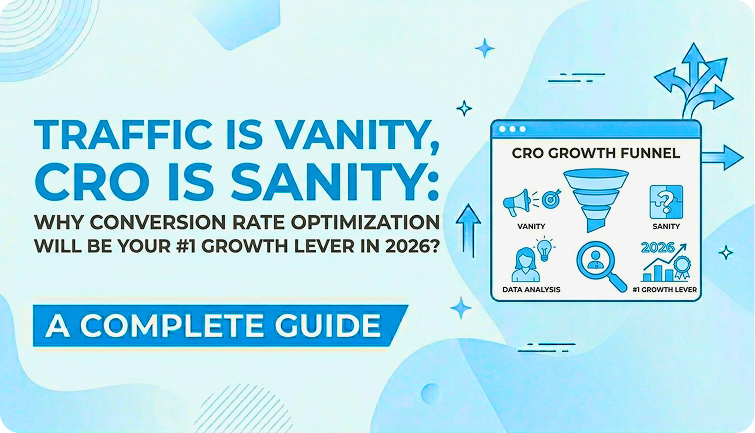
Sometimes, people get excited about seeing big numbers on their website dashboard. Hundreds or even thousands of visitors a day can feel like a victory. But then you check the sales, the sign-ups, the leads, and suddenly those numbers look empty. Most visitors leave without doing anything useful. That’s the tricky part about traffic. It shows potential, but it doesn’t always show results. Conversion rate optimization, or CRO, is what actually turns that potential into something real.
Think of it this way: a store can have a long line outside, but if no one buys anything once they get inside, the line is just for show. CRO is what makes people buy once they’re inside the store. In this blog, you will learn what CRO is, why it matters, and how small changes can give big results for your website.

Start Improving Your Conversion Rate Today
Small changes can lead to big growth in sales and leads.
What Is Conversion Rate Optimization in 2026?
CRO means improving a website so more visitors take action. The action can be anything. Buying a product, filling out a form, downloading something, or even clicking a button. The key thing here is that CRO is data-driven. You aren’t guessing what might work. You watch how people behave, where they stop, and then figure out small changes that can improve results. Over time, these small improvements add up.

How does it support an e-commerce business?
A website helps new customers find your business. When someone searches on Google, your website can appear in the results. That is how many small brands get their first sales. Websites are also easier to update. If you want to change a price or add a new product, you can do it quickly. No need to wait for approval from an app store.
For new businesses, web design and development are often the first step. Because it costs less and can work on all devices at once. Mindcob Digital Marketing Agency offers web design and development services. They help businesses create clean and simple websites that are easy to use. The following table shows the advantages and disadvantages of an e-commerce website:
> Why CRO Has Shifted from Tactic to Core Profitability Function
Before 2026, CRO was seen as extra work, something to try later. Now, it’s a core part of how companies grow and make money. Traffic is just the start. Because ads are expensive. Getting traffic costs money. CRO basically means extracting value from the visitors you already have.
Imagine 1,000 visitors come to a website. Only 10 buy something. That is 1%. If you double your conversion rate to 2%, that’s 20 sales without spending more on ads. That’s the kind of impact CRO has. Many businesses now rely on CRO services and agencies to make sure every visitor counts. It protects money. It increases profit without chasing more traffic.
Why Traffic Is Vanity in Today’s Digital Economy
Big traffic numbers look impressive. Teams celebrate as reports look good. But sometimes 90% or more visitors leave without doing anything. That traffic did not help much. It is like people entering a shop, looking around, and walking out. No purchase, no question, and doing nothing. Marketing CRO resolves this issue. Its main focus is on conversion. Traffic alone is not success. Action is the real success
> Why Rising Customer Acquisition Costs Demand Better Optimization
Ads are not cheap anymore. Every click costs money. If the website does not convert well, money gets wasted slowly and quietly. CRO services help reduce this waste. When more visitors convert, the cost per sale becomes lower. That means a better return. Businesses feel more stable. It is not about spending more. It is about using what you already have in a smarter way
> How AI and Zero-Click Search Are Changing Visitor Intent
Search engines now show answers directly. Many people do not click on websites anymore. So when someone does click, they usually have a real interest. These visitors do not want confusion. They want clear information, fast-loading pages, and easy steps. CRO helps match that expectation. If the website feels slow or messy, they leave quickly.
Think of it like someone walking into a store already knowing what they want; they won’t wait if they can’t find it.
Why CRO Will Be the #1 Growth Lever in 2026
Many businesses look at traffic growth. But smart businesses look at revenue per visitor. How much money does each visitor bring? If conversion goes from 1% to 2%, the results double. That is powerful because with no extra ad spend, you can improve its performance. CRO marketing focuses on this efficiency. Each visitor is worth more
> Why CRO Creates Compounding Growt
When ads stop, traffic drops. But CRO improvements stay. If a page performs better today, it will likely perform better tomorrow too. It is like fixing small holes in a bucket. Once fixed, water does not leak anymore. Every visitor counts more. Over time, these small gains build strong results.
What Are the Performance Benchmarks for 2026?
The following table shows how websites are doing in 2026. It tells the usual conversion rate for different types of sites and what a good rate looks like. Every site is different, so your numbers might be higher or lower. Use these numbers to see where your site stands and to know if you can improve. It gives a simple idea of what to aim for
| Industry Segment | Average Conversion Rate | Optimized Target |
|---|---|---|
| Global E-commerce | 1-3% | 3%+ |
| Service-Based B2B | 2-5% | 5%+ |
| Landing Pages | 4-7% | 10%+ |
These numbers come from different studies by Statista, HubSpot, and Smart Insights. But every website is different. The real conversion rate can change depending on who visits, where the traffic comes from, and the type of business.
What Are the Key Strategic Pillars of CRO in 2026
The following are the key strategic pillars of CRO in 2026:
> Intent-Based Optimization
Every visitor is not the same. Some people are just checking things. While others are ready to buy your services. New visitors may need more details, while returning visitors may just want a good deal. A website should understand these differences; CRO works better when the site shows what people actually need. Even small changes in words or buttons can improve results.
> Mobile-First Experience Optimization
Most people visit websites on their phones. If a site is difficult to use on mobile, they leave fast. Forms should be short, buttons must be easy to press, and pages must load quickly. Many businesses lose sales because their mobile pages feel slow or confusing. CRO focuses on these small things and makes the mobile experience simple and clear for users.
> Reassurance-Driven Checkout Systems
Many people leave during checkout. Extra fees, long forms, or forcing account signup can push them away. A simple checkout builds trust. Let people buy as guests. Show prices clearly. Make payment steps easy. Small changes here can increase sales quickly. CRO services often work a lot on improving this step.
> Ethical Personalization Using First-Party Data
Personalization does not mean spying. You must use the data to help visitors. For example, try to show products they just viewed or saved in their cart. This makes buying easier. It saves time. When done in a simple way, it helps people feel comfortable and ready to purchase.
Let Experts Handle Your CRO Strategy
We optimize every step of your funnel for better results.
How to Build a Structured CRO Framework
You can build a structured framework by following these steps:
Step 1: Check Your Current Numbers
First, check what your conversion rate is right now. Where do people leave the website? You need to know this first. If you don’t check the numbers, you are just guessing.
Step 2: Find Where People Get Stuck
Watch how visitors use your website. Where do they stop? Maybe the form is too long, the page loads slowly, or the buttons are not clear. Even small problems can make many people leave.
Step 3: Think of Simple Fixes
After you see the problems, think about small and easy changes. It could be making the form shorter, changing the words on the button, or making the headline easier to understand. Every change should have a reason. Do not change things just for no reason.
Step 4: Test One Change at a Time
Change only one thing first. Then compare the old page and the new page. See which one works better. Do not guess. Let the numbers show what is better.
Step 5: Check Results and Improve Again
Now look at the results. Did sales go up? Did you get more leads? Keep the changes that work. Remove the ones that do not help. Many businesses take help from CRO services or agencies because this work needs time and careful checking.
Where Should You Focus First, Traffic or Conversion Rate Optimization?
If a business has very little traffic, then building traffic first makes sense. But if traffic is already stable and conversions are low, CRO should come first. The better order is simple. Improve performance, test results, and then scale traffic. This approach saves money and builds stronger growth.
Conclusion
Conversion rate optimization helps businesses use their traffic in a better way. It stops money waste and increases profit. It also makes the website stronger step by step. Mindcob, a digital marketing agency, provides conversion rate optimization services for businesses. Their expert team tests pages, optimizes content, and focuses on steady results.
Ready to Turn Visitors Into Customers?
Let us optimize your website for higher conversions and revenue.
FAQs About Conversion Rate Optimization
Many visitors look nice, but most leave without doing anything. CRO helps them take action. Without it, big traffic does not help much.
If very few people visit, get more traffic first. If visitors are already coming, fix CRO first. This way, you get better results without wasting money.


