

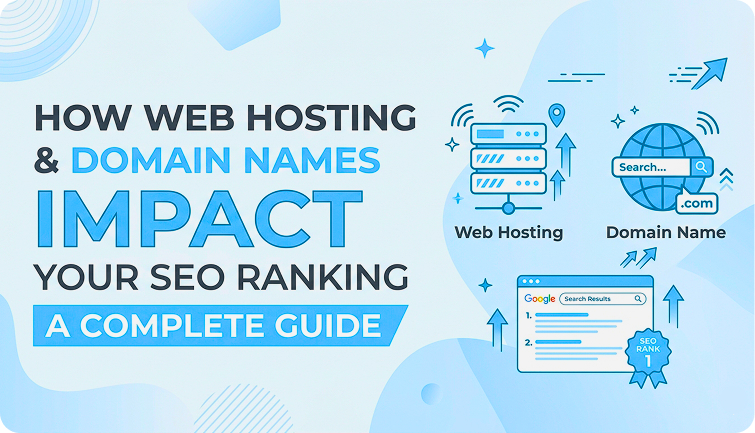
At first, many website owners think ranking on Google is only about content. They focus on blog posts, keywords, and backlinks. But behind every site, there is something quieter working in the background. The web domain and hosting services hold everything together. When someone sets up web hosting services and domain names, they often treat them as simple technical steps. Buy a domain name and web hosting, upload the site, and move on. But things are not that simple. Web hosting and domain choices shape how fast a site loads, how secure it feels, and how reliable it stays. These small details slowly affect Google rankings over time. In this blog, you will learn what web hosting is and the impact of web hosting and domain names on SEO


Choose the Right Hosting for Better SEO
Don’t let slow servers hurt your rankings—start with
a solid foundation.
What Is Web Hosting and Why Does It Matter for SEO?
Web hosting is the place where a website lives. All images, text, and code are stored on a server. When someone types a domain into the browser, that server sends the files back so the page can load. It sounds simple, but it is the part people usually forget. Google’s crawler also visits that same server. If the server is slow, unstable, or offline, Google notices it.
For example, a small online store once moved from a stable server to a very cheap plan to save money. At first, nothing looked wrong. A few weeks later, pages started loading more slowly during busy hours. Rankings slowly dropped. The owner blamed the content. The real issue was the hosting and domain setup struggling behind the scenes. Web hosting and domain decisions shape performance. They are not loud ranking factors, but they sit under everything.
How Web Hosting Services Impact SEO Rankings
Web hosting services impact SEO ranking in the following ways:
Site Speed and Core Web Vitals Affect
Google has clearly stated that page speed affects rankings. When a site loads slowly, users leave, and it happens fast. Most people will not wait more than a few seconds. High-quality web hosting services and domain names support faster speed through better storage, such as SSD or NVMe drives. Servers that support HTTP/2 or HTTP/3 send files more smoothly. Caching helps pages load faster for repeat visitors.
A slow server creates a chain reaction. Slow load time leads to frustration; visitors leave the page, and the bounce rate increases. Many site owners search for the best web and domain hosting services after they notice speed issues. It would have been easier to choose wisely from the start.
Server Uptime and Reliability
Uptime means how often a site stays online. A 99.9% uptime guarantee may sound like marketing talk, but it matters. When a server goes down often, Google’s crawlers may fail to access pages. If Google repeatedly tries to crawl a site and finds errors, it may reduce how often it visits. In extreme cases, pages can disappear from search results. This is rare, but it happens when reliability is poor.
Server Location and Latency
Server location affects latency. Latency is simply the time it takes for data to travel between the server and the visitor. If a business targets customers in Canada but hosts its server far away, the site may load more slowly there. Search engines care about user experience in each region. Faster loading for local visitors can support better local rankings. Choosing web hosting and domain settings that match the target audience’s location gives this edge.
Security and HTTPS
Security is no longer optional. Google confirmed HTTPS as a lightweight ranking signal years ago. When a site uses SSL, the address changes from HTTP to HTTPS. That small “S” builds trust. Without SSL, browsers show warnings. Users hesitate, and click-through rates drop. That alone can affect search performance. Reliable hosting providers often include free SSL certificates.
The best domain registrar and web hosting platforms make it easy to activate. Ignoring SSL may seem harmless, but trust once broken is hard to rebuild. Hacked sites face bigger problems. Malware warnings can remove a site from search results completely. Recovery takes time and effort.
Scalability
Traffic does not stay the same forever. Sometimes a blog post goes viral. Sometimes a sale brings a surge of visitors. If hosting cannot handle the spike, the site slows down or crashes. Shared hosting plans often struggle during heavy traffic. One website owner once celebrated a social media mention. Traffic doubled in one day, and the server froze. What should have been a great moment turned stressful. Scalable hosting, like VPS or cloud setups, adjusts better. It helps keep your SEO ranking safe when your website is growing.

Scale Without Crashing
your rankings.
What Is the Impact of Domain Names on SEO?
Here are some simple ways domain names affect SEO.
Brandable Domains Improve Click-Through Rates
Your domain name is the first thing people see. It creates the first impression of your website. If the name is clear and easy to remember, more people may click on it. A short, clear name feels safer. People are more likely to click it in search results. Imagine two listings. One has a simple brand name. The other looks stuffed with keywords and hyphens. Most users choose the cleaner option. Higher CTR sends positive signals to Google. Domain name and web hosting decisions together build credibility. Even if Google treats them technically equal, users do not.
Top-Level Domains (TLDs)
Google has stated that common TLDs like .com, .net, and .org are treated equally. Yet user perception still matters. Many users trust .com more. It feels known. People trust it more. Because of that, they may click on it and stay longer on the website. Search engines do not give a higher ranking just because of a normal domain ending. But people’s actions improve the ranking of the site.
Country-Code Domains
Country code domains like .uk or .ca show a clear country signal. They tell search engines that the website is made for people in that country. For example, if a small bakery in Canada uses a .ca domain, it looks more local to Canadian users. It matches the place. If a business works in only one country, this type of domain can help it show better in local search results.
Keywords in Domains
Years ago, exact match domains gave a big ranking boost. That is no longer true. A domain like best-cheap-shoes.com does not guarantee high rankings. Still, a relevant word in the domain can help users quickly understand the site’s purpose. It adds clarity. But content quality remains far more important. Some people chase the best domain name and web hosting service, thinking the keyword alone will solve SEO.

Find the Perfect Domain Name
Common Mistakes That Damage SEO
Choosing Hosting Only Based on Price
Cheap hosting may look attractive. But lower cost often means limited resources and slower servers. Over time, performance issues show up. Saving money early can cost visibility later.
Ignoring SSL Security
Skipping SSL sends the wrong message. Browsers warn users. Trust drops. Even a simple blog needs HTTPS now. It is basic protection.
Frequent Domain Changes
Changing domains often resets trust signals. Redirects can help a little. But trust and power of a website do not come back fast. It takes time. In Search engine optimization, keeping things stable is very important.
Not Monitoring Uptime
Downtime sometimes goes unnoticed by site owners. But search engines notice. Regular monitoring tools can alert to issues early.
Buying Spam-Affected Expired Domains
A domain with toxic backlinks carries baggage. Cleaning it up takes effort. Starting fresh is often easier.
Overloading Cheap Shared Hosting
Shared hosting means sharing resources. If other sites on the same server consume heavy traffic, performance drops. This “bad neighbor” effect quietly hurts rankings.
Conclusion
Web hosting services and domain names play a big role in how a website shows up on Google. It matters for site speed, safety, trust, and how stable the website stays. All these things work in the background every day, even when no one sees them. Mindcob Digital Marketing Agency offers Web Hosting & Domain Service that practically supports SEO.
Get SEO-Ready Hosting & Domain Services
Let experts handle your setup so you can focus on growing
your business.
Frequently Asked Questions
Yes, if your hosting is slow or often down, moving to better hosting makes your site faster and more stable. Google notices that.
It can be bad. If you split your website into many domains, Google may get confused, and your site may rank lower.
You should check every month. Use simple free tools to see if your site is up and loading fast.


