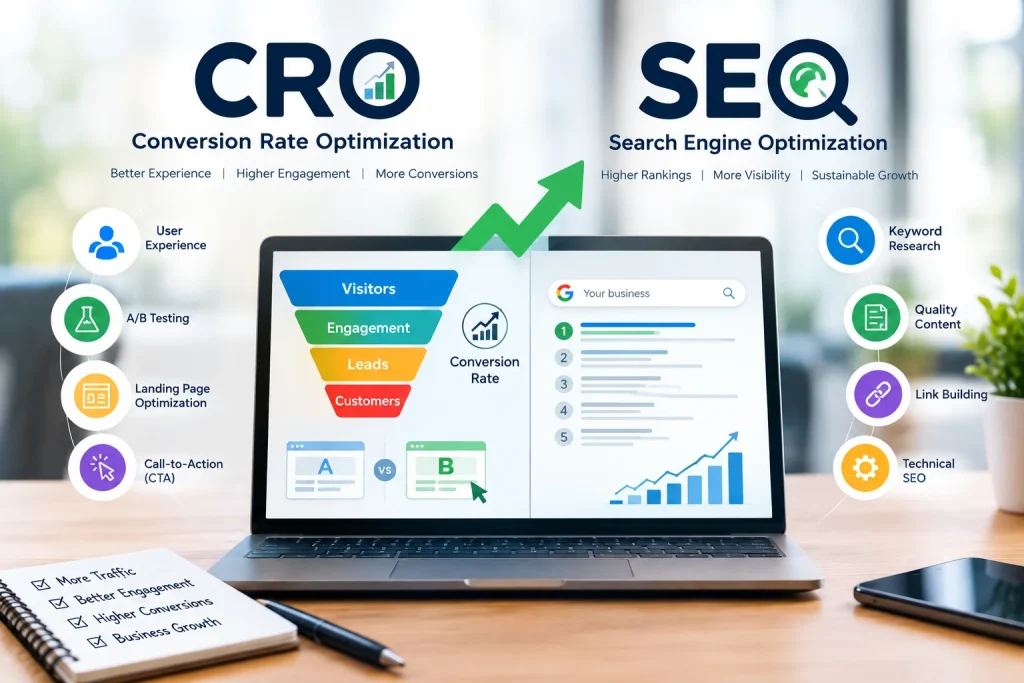
Search clicks are getting harder to win. AI Overviews cut organic clicks by 38% on searches where they appeared. This means each visitor who reaches your website matters more than before. SEO gets people to your website. CRO gets them to do something once they’re there, such as call you, fill in a form, or buy. You need both strategies, because traffic that does nothing is just a number on a screen. CRO and SEO also help each other. A fast, clear site that people trust tends to rank better, and it sells better too.
This blog is for Canadian business owners. Also for anyone who runs a site for a Canadian business. You will learn how CRO helps traffic grow, how it turns visitors into leads, how user experience links the two, and how to build a simple plan.
What Are CRO and SEO, and How Are They Different?
What Is Conversion Rate Optimization (CRO)?
CRO (conversion rate optimization) means getting more of your visitors to act. The action can be a call, a form, a booking, or a sale. To find your rate, divide the actions by the visitors. Then multiply by 100. If 20 out of 1,000 visitors act, your rate is 2%. Picture a hardware store in Saskatoon where many people walk in, but few buy. The store does not need more people. It needs clearer signs and a better layout.
What Is SEO?
SEO means search engine optimization. SEO helps your pages show up when people search for what you offer. It has three parts. Content that answers real questions. A site that search engines can read. And some proof that people trust you. In the same store, SEO is the sign on the road that brings people to the door.
How Are CRO and SEO Different?
SEO is about being found. CRO is about getting action. They also work in a cycle. SEO brings visitors who need what you offer. CRO removes anything that makes it hard to act. A better experience then helps your pages do well in search over time.
| SEO | CRO | |
| Goal | Get found in search | Get visitors to act |
| Main work | Content, technical setup, trust | Page layout, messages, testing |
| Key numbers | Rankings and traffic | Conversion rate and form fills |
Why Does CRO Matter More for SEO Traffic in 2026?
Fewer Clicks Make Every Visit Count
Google now shows AI Overviews, which are short AI answers at the top of some results. CIRA’s 2026 report found that 46% of Canadians used a generative AI tool in the past year. More than half of those users used it as a search engine. When people find answers without visiting a website, each visitor who does arrive matters more. A local business in Halifax may get only a few hundred visits a month. It cannot afford to waste any of them.
Get More Return From Traffic You Already Earned
Think about two websites. Each gets 1,000 visitors a month. The first turns 5 visitors into leads. The second turns 20. The traffic is the same, but the second site wins four times more business. Paying for more visitors is one way to grow. Improving the page is often cheaper. Organic traffic conversion work gets more leads from the visitors SEO already brought, so the cost of each lead falls.
How Does CRO Help Drive More Organic Traffic?
CRO does not send visitors by itself. It helps traffic grow in indirect ways.
Clearer Titles and Descriptions Earn More Clicks
Your title and description are the first things people see in search results. CRO thinking can improve them. Use plain words. Say what the reader gets. Give them a reason to click. A renovation company in Vancouver could change “Home Services” to “Kitchen Renovations in Vancouver: Free Quote.” The ranking stays the same, but more people click. The site gets more traffic without moving up.
Satisfied Visitors Send Better Signals to Google
Google says its ranking systems aim to reward helpful content and a good page experience. Google’s own guidance tells website owners to create content that helps people, not content made only to please search engines. Picture a searcher in Mississauga who clicks a plumber’s page. The page answers the question at once and shows a phone number. The visitor has no reason to go back and try another result. Google does not share how much weight any single signal carries, so nobody can promise a ranking boost from CRO. CRO can make a page more helpful, and helpful pages are what Google says it wants.
Direct Answers Are Easier for Search and AI Tools to Use
Start a page with a short, direct answer of about 40 to 60 words. Add the detail after it. Clear answers and tidy headings make it easier for Google and AI tools to pick up your content. A snow removal company in Richmond could open its pricing page with one plain line on what a seasonal contract includes.
How Does CRO Turn SEO Traffic Into More Conversions?
SEO brings visitors who already have a need. CRO makes sure the page answers that need and shows the next step. This is how SEO traffic conversions grow, and a sound SEO optimization strategy supports it from the start.
Match the Page and CTA to Search Intent
Search intent is the reason behind a search. A person who types “how to winterize a pipe” wants help, not a sales pitch. Offer a guide or a checklist. A person who types “plumber in Mississauga” is ready to call. Show a phone number and a quote button at the top. Show the main benefit on the first screen, so visitors know they are in the right place.
Remove Friction Between the Click and the Action
Friction is anything that makes it hard to act. Long forms, unclear buttons, slow pages, and missing proof all stop people. Show prices in Canadian dollars, a local address, and a phone number with your area code. Add real reviews and clear policies. If you serve Quebec, offer a French version of key pages. Fix one problem at a time. Small gains in website conversions SEO work add up when the traffic is already there.
Guide Visitors With Internal Links and Clear Next Steps
Internal links connect your own pages. Link a blog post to the service page that matches it, and use plain words as the link text. A post about website speed can point to your web design services. Give each page one main action.
Personalize the Journey for Organic Visitors
Personalization means showing the right content to the right visitor. Use simple data, such as pages a visitor has seen, to suggest a related guide or a better next step. A visitor from Ontario could see Ontario service areas first. Do not show Google a different page from the one users see. Be open about the data you use.
How Does CRO Improve User Experience and Support SEO?
Search engines want pages that satisfy the searcher. CRO is the work of making a page easy to use. Good website conversion SEO work starts with these four parts.
Easy Navigation and a Clear Layout
People want answers fast. A few seconds: that’s all you get. Keep the menu simple. Write headings that say what the section is about. If a button does something, the button text should say it. “Get a quote” works. “Submit” doesn’t say much.
Mobile-First Design
Many people search on their phones, for example, when looking for a nearby shop in Montreal. Keep forms short and buttons large. Put the phone number and key details at the top of the screen. Test your page on a real phone.
Fast Page Speed and Core Web Vitals
Core Web Vitals are Google’s checks for speed and comfort. Google lists the good targets on web.dev. The main content should load in 2.5 seconds or less. The page should respond to taps within 200 milliseconds. The layout should not jump around, with a shift score of 0.1 or less. Slow pages make visitors leave before they see your button.
Helpful Content That Is Easy to Read
Use short paragraphs and clear headings. Answer the question first, then explain. Many people in Canada read English as a second language, so simple words help every visitor.
How to Build a CRO Strategy for 2026 Using SEO Data
Many owners say, “I get traffic, but nobody contacts me. Where do I start?” You can build the best CRO strategy using SEO data.
Step 1: Decide Which Numbers Matter
The two teams need to decide together what they will measure. Leads or sales that come from organic visits. How far people scroll. The bounce rate on your main landing pages. That’s enough to start. Next, set up key events in Google Analytics 4 (GA4). A key event is any action you care about. A form submission counts. So does a click on your phone number. Do this before anything else, or you will have nothing to measure later. Then filter GA4 and Google Search Console to Canada. You only want to see the visitors you actually care about.
Step 2: Find Pages With Traffic but Few Conversions
Open Google Search Console. Look for pages with lots of impressions and clicks. People are coming, but are they doing anything? Often not. Don’t just count traffic. Count leads or sales for each organic visit. A page with 1,000 visits and no leads is not doing its job.
Step 3: Check If the Page Matches the Search
Read the search terms that bring people to each page. Then read the page as a visitor would. If the search and the page do not match, a new button will not help. Change the headline and the opening lines first.
Step 4: Spot Friction With Heatmaps and Recordings
A heatmap shows where people click and scroll. A recording shows one visit from start to end. Free tools such as Microsoft Clarity offer both. Look for places where visitors stop, tap things that do nothing, or leave a form half done.
Step 5: Test Safely, Measure, Repeat
Change one thing at a time, so you know what worked. Don’t only count traffic. Count the leads or sales that come from each organic visit. A page can get a lot of visits and still do nothing for you. Now the testing part. Google has its own testing rules, and you should follow them. Googlebot must see the same page that users see. Showing it something different is a problem.
If your test uses separate URLs, add a canonical tag. It simply tells Google which version is the main one. For tests that are temporary, use 302 redirects. Also check that your testing tool does not break how the page loads or gets indexed.
What Mistakes Hurt Both CRO and SEO?
Changing Too Many Things at Once
If you change the headline, the colours, and the form together, you cannot tell which change helped. Make one change, wait for enough visits, then move to the next.
Adding Pop-Ups That Block the Content
A pop-up that covers the page, especially on a phone, annoys visitors and can hurt search results. If you need one, keep it small and easy to close.
Tracking SEO and CRO in Separate Reports
When CRO and SEO teams use different reports, nobody sees the full picture. Put organic traffic conversion data, leads, and sales in one report.
Conclusion
SEO brings the visit, and CRO earns the action. Together, CRO and SEO help you get more from every search click. Conversion rate optimization is not about tricks. It is simple: Make the pages clear, fast, and easy to use. Start small. Pick one page, fix one problem, and measure the result. A steady CRO strategy 2026 and a sound SEO optimization strategy will pay back over time. If you want expert help, Mindcob Digital Marketing Agency works with Canadian businesses to connect SEO traffic conversions with real leads. Contact our team today for a free CRO and SEO review, and let us turn your search visitors into customers.
How much traffic do I need before CRO testing works?
A/B tests need many visits to give a trustworthy result. A small website, such as a local shop with a few hundred visits a month, should begin with heatmaps and simple fixes. Start testing when traffic grows.
Should I fix SEO or CRO first?
If almost nobody visits, start with SEO. If people visit but do not contact you, start with CRO. Over time, the best results come from doing CRO and SEO together.
How long does it take to see results from CRO and SEO together?
CRO changes can show results within weeks, once enough people have visited. SEO usually takes longer. Give it time. Track your CRO strategy 2026 results for a few months before you decide anything.
Can small websites do CRO without paid tools?
Yes. Google Analytics, Google Search Console, and a free heatmap tool such as Microsoft Clarity are enough to start. Careful reading of your own reports often finds the biggest website conversion SEO problems.
What is a good conversion rate?
There is no single number. Divide actions by visitors, then multiply by 100. Compare the result with your own past results and your industry. Aim to beat your own number each quarter.