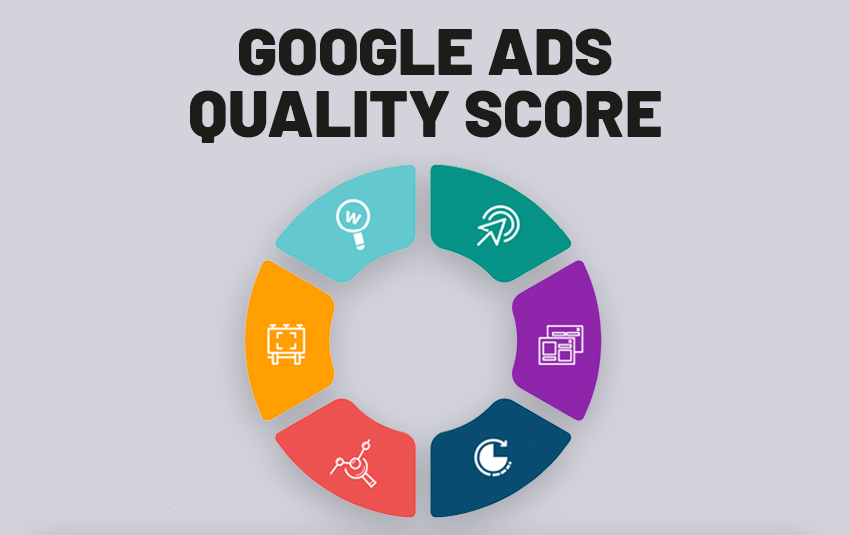
If you run Google Ads, you may have seen a Quality Score beside your keywords. It is shown as a number from 1 to 10, and a low number can make you wonder if you are paying too much for clicks. Many advertisers assume that a higher Google Ads Quality Score simply means a lower Google Ads CPC. The answer is different. Quality Score helps you find problems with your keywords, ads, and landing pages, but the score itself does not directly set the price of a click. Google also looks at ad quality during each auction, along with your bid, competition, search context, and other factors. This helps you make better PPC decisions.
What Is Google Ads Quality Score?
Google Ads Quality Score is a rating from 1 to 10 that Google gives to keywords in Search campaigns. It is a diagnostic tool. It helps you judge how relevant your ad experience may be compared with other advertisers for similar searches. The Google Ads Quality Score looks at three areas: expected click-through rate, ad relevance, and landing page experience. A lower Google Ads Quality Score points to an area worth checking. One point is often misunderstood. Google Ads Quality Score is not itself used as an input in the ad auction. So, you should not think of the 1–10 number as a price tag attached to every click. Google uses the score to help advertisers understand where they may improve their campaigns.
How Is Quality Score Calculated?
Google uses three main components when calculating the Quality Score. Each one looks at a different part of the user’s experience. The three parts matter more than the final number alone.
Expected Click-Through Rate
Expected click-through rate, or expected CTR, is Google’s estimate of how likely people are to click your ad when it is shown for a search. It is not simply the same thing as the CTR you see in your account. An ad that fits the search may have a better chance of getting a click. Clear wording can help too.
Ad Relevance
Ad relevance is about how closely your ad matches the searcher’s intent. Think about someone searching for “commercial lawn care Vancouver.” An ad about commercial lawn care in Vancouver is more closely related than a broad ad about all types of home services. When keywords have similar intent, you have more room to write ad copy that speaks directly to that search. One generic ad should not try to fit many different needs.
Landing Page Experience
The experience after the click also matters. The landing page needs to fit the search that brought the visitor there. It should also deliver what the ad said the person would find. For example, someone clicking an ad for a specific service should not end up on a page with only a few lines about that service. The page should give visitors the information they came for without making them search around for it. It also needs to work well on phones. Things like slow loading or poor usability can hurt the experience too, but page speed by itself does not decide the Quality Score.
Does Quality Score Affect Google Ads Costs?
Google Ads Quality Score does not directly set your cost per click Google Ads charges. The 1–10 diagnostic score is not simply placed into the auction and multiplied by your bid. Still, the things behind that score matter. Google evaluates ad quality during the auction. That evaluation can affect Ad Rank, which can affect whether and where an ad appears. Better ad quality can also help an advertiser get a lower actual CPC in some situations.
Quality Score Does Not Directly Set Your CPC
Imagine two keywords with different Quality Scores. It would be wrong to say that Google automatically charges the keyword with the lower score more for every click. Your cost per click Google Ads can change because of competition, your bid, the search itself, Ad Rank thresholds, and other auction factors. Click costs can also differ across searches. This is why a score should be treated as a clue. If a keyword has a low score, check the three components and look for a real problem. Do not assume the number itself is causing the bill.
Why Better Ad Quality Can Still Lower CPC
Google says a better ad quality score can often support lower costs per click and better ad positions. That does not mean every improvement will produce the same savings. For example, suppose two advertisers compete for a similar search. One has a strong match between the keyword, ad, and landing page. The other has a weak match. Even with a higher bid, the second advertiser may not compete as well. When reviewing PPC ad costs, focus on the reasons behind poor quality and PPC ad costs rather than trying to push the displayed score higher just for the sake of it.
How Quality Score Connects to Google Ads Ranking
Google Ads ranking is mainly discussed through Ad Rank. Ad Rank helps determine whether an ad can show and where it may appear. It is calculated during the auction, not from the 1–10 score alone. Google considers factors such as the bid, ad quality, the search context, competition, and Ad Rank thresholds. The expected impact of ad assets can also play a role.
Why a Higher Bid Does Not Always Win
Picture two advertisers bidding on the same type of search. Advertiser A has a useful ad and a closely matched landing page. Advertiser B bids more, but the ad does not match the search as well. The higher bid does not automatically make B the winner. Ad Rank looks at more than money. The old idea of “bid multiplied by Quality Score equals Ad Rank” is too simple. The displayed Google Ads Quality Score is a diagnostic metric.
What Is a Good Google Ads Quality Score?
A good Quality Score depends on the keyword and the situation. There is no single number that guarantees a successful campaign. As a simple benchmark, 1 to 3 suggests that you should look for problems, 4 to 6 is a middle range, and 7 to 10 is generally stronger. But these are practical ranges, not Google requirements. Do not judge a keyword by its score alone. Check its CTR, conversion rate, cost per conversion, and revenue or lead value. A high score cannot rescue a keyword that never produces useful business results.
How to Check Your Quality Score in Google Ads
You can check the score directly inside your Google Ads account.
Open Your Search Keywords Report
Open Google Ads and select the Search campaign you want to review. Go to the Keywords or Search keywords area. Quality Score is shown at the keyword level, so this is where you can examine individual keywords rather than looking only at campaign totals.
Add Quality Score Columns
Use the Columns option and choose to modify the columns. Look for the Quality Score section and add the metrics you want to review. Add Quality Score, Expected CTR, Ad Relevance, and Landing Page Experience. Google also provides historical versions of several Quality Score metrics, which can help you see how the evaluation has changed.
Read the Three Quality Score Components
Do not stop after seeing the 1–10 number. Look at whether each component is marked Above average, Average, or Below average. A below-average expected CTR may point to an ad that is not getting enough interest. Below-average ad relevance can suggest a mismatch between the search and the ad. A weak landing page experience suggests that the page after the click needs a closer look.
Check Quality Score Alongside Other Metrics
A Quality Score PPC review can find problems; use performance data to decide what to do. Look at CTR, conversions, cost per conversion, and other results that matter to the business. A low score does not automatically mean you should pause a keyword. A high score does not prove that a keyword is profitable either.
How to Improve a Low Quality Score
Improving a weak score usually means working on the areas that Google is already pointing you toward.
Tighten Your Ad Groups
Group keywords that have closely related meanings and search intent. If one ad group contains keywords for several unrelated services, writing one relevant ad becomes harder. Right group keywords give you more control over the message. The ad can focus on user intent instead of trying to cover everything at once.
Match Your Ad Copy to Search Intent
Your ad should make sense for the search that triggers it. Use the main keyword theme naturally, explain the offer clearly, and make the benefit easy to understand. You do not need to force an exact keyword into every line. Relevance matters more than awkward wording. If the person searches for a specific service, the ad should make it clear that the service is what they will find after clicking.
Improve Your Landing Page
Make sure the landing page delivers what the ad promised. If the ad talks about one service, the page should make that service easy to understand. Keep key information easy to find and check the page on a phone. A relevant, useful page gives visitors a better reason to stay after the click.
Common Google Ads Quality Score Mistakes to Avoid
Treating Quality Score as Your Main KPI
Quality Score PPC analysis can help you diagnose a problem, but it is not the final measure of campaign success. Leads, sales, cost per conversion, and revenue usually tell you much more about whether the campaign is working.
Assuming a High Score Guarantees Cheap Clicks
A high score does not lock in a low CPC. Competition and the details of each auction still affect what you pay.
Ignoring the Landing Page
Rewriting ads while ignoring the landing page may not solve the real problem. If the page does not match the search or ad, the campaign can still struggle.
Using the Old Quality Score × Bid Formula
The simple formula is still repeated across many PPC articles, but it can give the wrong impression. The displayed Quality Score is a diagnostic metric. Ad Rank is determined during the auction using several factors.
Conclusion
Google Ads Quality Score is useful when you know what it can and what it cannot tell you. The 1–10 number helps you spot possible issues with expected CTR, ad relevance, and landing page experience. It does not directly decide your CPC. If you need help understanding why your ads are costing more than expected, you can get help from the top Professionals in Canada. Mindcob Digital Marketing Agency can review your Google Ads campaigns. Their experts evaluate keywords, ads, and landing pages. Then give you suggestions to improve performance. You can contact them for professional Google Ads management and optimization.
How long does it take for Quality Score to change?
Quality Score is usually calculated when Google has enough search data. You may not see any change right after an edit on an ad or landing page. Google evaluates any keyword based on search activity related to it.
Can changing keyword match type improve Quality Score?
Changing match type alone is not a direct way to improve Quality Score. Google explains that the score is based on historical impressions for exact searches. Match type may affect traffic, but it is not a shortcut for raising the score.
Should I pause a keyword just because it has a low Quality Score?
No, a low score is not proof that a certain keyword has no value. You first have to check the keyword’s conversions, CPC, CTR, search intent, and landing page experience.